Cholesteatoma: Care Instructions
Overview
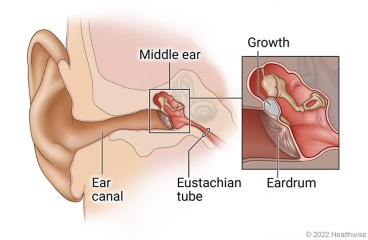
A cholesteatoma (say "kuh-LESS-tee-uh-TOH-muh") is a growth (cyst) inside your ear. The most common cause is
a problem with the eustachian tube. Once the growth starts, it can keep growing and cause ear infections. You
may feel pain and pressure in or near your ear. You also may have bad-smelling fluid that drains from your
ear. You may lose hearing in that ear. Hearing may come back after the growth is removed.
Your doctor may do tests to find out the size and shape of the growth. Your doctor may clean your ear and
prescribe antibiotics if you have an infection. In most cases, people have surgery to remove the growth. After
surgery, you will need follow-up care to be sure the growth and infections don't come back.
Follow-up care is a key part of your treatment and safety. Be sure to make and go to all
appointments, and call your doctor if you are having problems. It's also a good idea to know your test results
and keep a list of the medicines you take.
How can you care for yourself at home?
-
If your doctor prescribed antibiotics, take them as directed. Do not stop taking them just because you
feel better. You need to take the full course of antibiotics.
-
Take an over-the-counter pain medicine, such as acetaminophen (Tylenol), ibuprofen (Advil, Motrin), or
naproxen (Aleve), as needed. Read and follow all instructions on the label.
-
Do not take two or more pain medicines at the same time unless the doctor told you to. Many pain medicines
have acetaminophen, which is Tylenol. Too much acetaminophen (Tylenol) can be harmful.
-
To ease pain, put a warm washcloth or a heating pad set on low on your ear. You may have some drainage
from the ear.
-
If you are going to have the growth removed, your doctor will give you instructions for care before and
after surgery.
-
Do not put anything into your ear canal. For example, do not use a cotton swab to clean the inside of your
ear. It can damage the inside of your ear. If you think you have something inside your ear, ask your doctor
to check it.
When should you call for help?
 Call your
doctor now or seek immediate medical care if:
Call your
doctor now or seek immediate medical care if:
Watch closely for changes in your health, and be sure to contact your doctor if:
Current as of: September 27, 2023
Content Version: 14.0
Care instructions adapted under license by your
healthcare professional. If you have questions about a medical condition or this instruction, always ask
your healthcare professional. Healthwise, Incorporated disclaims any warranty or liability for your use of
this information.