Learning About Acute Cholecystitis
What is cholecystitis?
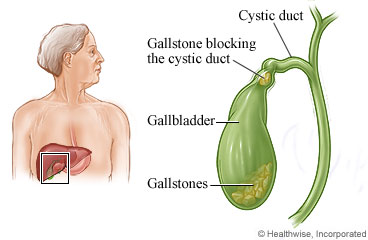
Cholecystitis (say "koh-lih-sis-TY-tus") is inflammation of the gallbladder. The gallbladder stores bile.
Bile helps the body digest food. Normally, the bile flows from the gallbladder to the small intestine.
A gallstone stuck in the cystic duct is most often the cause of sudden (acute) cholecystitis. The cystic duct
is the tube that carries the bile out of the gallbladder. The gallstone blocks the bile from leaving the
gallbladder. This results in an irritated and swollen gallbladder.
The disease can also be caused by infection or trauma, such as an injury from a car accident.
Cholecystitis has to be treated right away and likely in the hospital. Surgery is the usual treatment.
What are the symptoms?
The most common symptom of acute cholecystitis is steady and severe pain in the upper right part of the
belly. The pain can move to the back or the right shoulder blade. You may also have nausea, vomiting, or a
fever.
How is it treated?
Treatment for cholecystitis will depend on your symptoms and your general health.
The main way to treat this disease is surgery to remove the gallbladder. This surgery can often be done
through small cuts (incisions) in the belly. This is called a laparoscopic cholecystectomy. In some cases, you
may need a more extensive surgery.
You may need surgery as soon as possible. The doctor may try to reduce swelling and irritation in the
gallbladder before removing it. You may be given fluids and antibiotics through an I.V. You may also be given
pain medicine.
If you are not able to have surgery or cannot have it right away, the doctor may put a tube in the
gallbladder to drain the bile.
Follow-up care is a key part of your treatment and safety. Be sure to make and go to all
appointments, and call your doctor if you are having problems. It's also a good idea to know your test results
and keep a list of the medicines you take.
Current as of: October 19, 2023
Content Version: 14.0
Care instructions adapted under license by your
healthcare professional. If you have questions about a medical condition or this instruction, always ask
your healthcare professional. Healthwise, Incorporated disclaims any warranty or liability for your use of
this information.