Learning About Talking to Your Daughter About Puberty and Menstruation
How can you talk about puberty and menstruation?
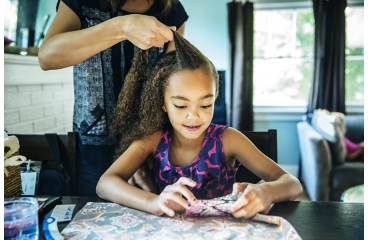
You might think there is some magical age to have "the talk" with your daughter. But it's a lot easier and
more effective to have an ongoing, open dialogue about all the changes her body and mind go through as she
grows and develops.
Here's some help with how to do that.
-
Let her know that puberty is just a normal part of growing up.
Think of teaching about puberty as an
extension of teaching about losing your teeth, or getting taller. Make sure to:
-
Use real, anatomical words (vagina, breasts, menstruation). This reduces confusion and shame.
-
Try to stay calm and relaxed. Your feelings and reactions will be noticed as much as your words.
-
Be open to questions. If you're not sure how to answer, you can say, "That's a good question. Can I
take a little time to get back to you with an answer?" Or you can say, "That's a good question. What
made you think of that?" Or "What do you already know about that?"
-
Let her know it's normal to feel excited, scared, confused, or awkward. For example, before puberty,
she may feel strong and coordinated. And when puberty hits, she may feel clumsy because her bones are
growing so fast.
-
Look for teachable moments.
Find ways to prompt conversation in everyday contexts. For instance, when
you're unpacking a grocery bag that contains deodorant:
When you're folding laundry that includes a bra:
When a tampon or pad commercial comes on TV:
-
Say: Have you ever heard of tampons or pads? Do you know what they're for?
-
Explain: Pads and tampons help collect the fluids that come from the uterus out through the
vagina after a girl gets her period (starts menstruating). Menstruation is a normal process that happens
to all girls, sometime between the ages of 9 and 15. It means your body is becoming more adult-like, and
is capable of growing a baby.
-
Say: I was wondering if any of your friends are wearing a bra, and if you might be interested
in going shopping for one?
-
Explain: Training bras can help girls feel more comfortable as their breasts develop.
-
Say: This needs to go in my bathroom. By the way, do you know what deodorant is for?
-
Explain: Deodorant is something people use under their armpits to help with body odor. If you
notice any changes in the way you smell, it may be time to wear it.
-
Explain what puberty means.
-
Let your daughter know that puberty is the time in her life when she starts to grow and change into an
adult. During this time, her body goes through a lot of changes.
-
Some girls start puberty early (ages 8-9). Others start later (ages 14-15). It's all normal. Let her
know that the time when puberty starts can vary. And it can take 3 to 5 years to go through it.
-
Help your daughter understand what changes to expect.
Body changes:
Brain changes:
Menstruation:
-
She may get her period a few years after other changes begin. At first, her periods may not be
regular.
-
If she wants to start carrying supplies, show her how to carry pads or tampons discreetly in a small
bag in her backpack.
-
You can also discuss ways to deal with cramps (heating pad set on low, pain medicines) or PMS (eating
healthy foods, exercising, or talking out emotions).
-
She may start to feel and think differently as she starts exploring how to be her own person. She may
feel grouchy or moody for no reason. Let her know these feelings are normal and won't last forever.
-
She may feel more independent, want to do more things on her own, or want more privacy or time with
friends.
-
She may first start to notice breast buds or a bit of hair growth under the arms or in the pubic area.
-
As her breasts develop, they may hurt or be tender. And one breast may be bigger than the other.
-
Later, she might notice that she has body odor, or starts to get pimples.
-
In time, her body may get rounder and taller.
-
Get help.
It can be great to provide helpful resources for your daughter. Ask the school counselor or
your pediatrician to recommend books, videos, or classes. Check out the website healthychildren.org for
more tips.
Current as of: October 24, 2023
Content Version: 14.0
Care instructions adapted under license by your
healthcare professional. If you have questions about a medical condition or this instruction, always ask
your healthcare professional. Healthwise, Incorporated disclaims any warranty or liability for your use of
this information.
© 2006-2026 Healthwise, Incorporated.