Coronary Angiogram with Possible Treatment: Before Your Procedure
What is a coronary angiogram?
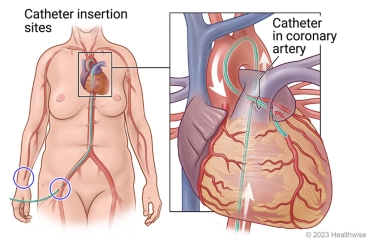
A coronary angiogram is a test to look at the blood vessels of your
heart. These are called the coronary arteries. You may have this
test to see if any of these arteries are narrowed or blocked. The
test may also be used to measure the pressure in your heart's
chambers. A doctor will put a thin, flexible tube into a blood
vessel in your groin or wrist. This tube is called a catheter.
During the test, the doctor moves the catheter through the blood
vessel and into your heart. Then the doctor puts a dye into the
catheter. This makes your coronary arteries show up on a screen.
Your doctor can see if the arteries are blocked or narrowed.
If you have a narrowed or blocked artery, the doctor may do an
angioplasty or a coronary stent procedure. In an angioplasty, the
doctor puts a catheter with a tiny balloon at the tip into the
blocked area and inflates it. The balloon presses the fatty buildup
(plaque) against the walls of the artery. This makes more room for
blood to flow.
In most cases, the doctor then puts a stent in the artery. A stent
is a small, expandable tube. It presses against the walls of the
artery. The stent is left in the artery to keep it open. This helps
blood flow. The catheter is removed from your body.
How do you prepare for the procedure?
Procedures can be stressful. This information will help you
understand what you can expect. And it will help you safely prepare
for your procedure.
Preparing for the procedure
|
|
|
|
|
|
|

|
-
Tell your doctor ALL the medicines, vitamins, supplements,
and herbal remedies you take. Some may increase the risk
of problems during your procedure. Your doctor will tell
you if you should stop taking any of them before the
procedure and how soon to do it.
|
|
|
|
|
|
|
What happens on the day of the procedure?
|

|
-
Follow the instructions exactly about when to stop eating
and drinking. If you don't, your procedure may be
canceled. If your doctor told you to take your medicines
on the day of the procedure, take them with only a sip of
water.
|
|
|
-
Take a bath or shower before you come in for your
procedure. Do not apply lotions, perfumes, deodorants, or
nail polish.
|
|
|
|
|
|
|
At the hospital or surgery center
When should you call your doctor?
Current as of: June 24, 2023
Content Version: 14.0
Care instructions adapted under license by your healthcare
professional. If you have questions about a medical condition or
this instruction, always ask your healthcare professional.
Healthwise, Incorporated disclaims any warranty or liability for
your use of this information.