Cardiac Event Monitoring: About This Test
What is it?
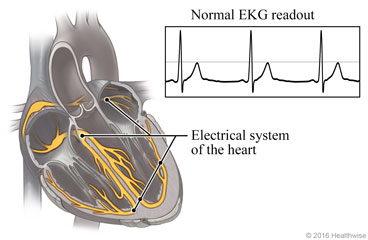
A cardiac event monitor is a small device that you wear or keep with you. It records the electrical activity
of your heart. It records times when your heartbeat is too fast, too slow, or irregular. These are called
cardiac events.
The monitor will give your doctor the same kind of information as an electrocardiogram (EKG or ECG). An EKG
shows the heart's electrical activity as line tracings on paper.
There are different types of monitors. Your doctor will choose the type that works best for you and is most
likely to help find your heart problem.
Why is this test done?
This test is used to look for irregular heartbeats. It can help your doctor find out what is causing symptoms
such as chest pain, fainting, or lightheadedness. It also can help the doctor see if treatment for an abnormal
heartbeat is working.
Many people have abnormal heartbeats from time to time. Because these kinds of heartbeats can come and go, it
may be hard to record one while you are in the doctor's office. Tracking your heartbeat for a longer time and
during your whole day makes it easier to record your cardiac events.
How is the test done?
If you are getting a monitor with electrode pads on your chest:
-
Several areas on your chest may be shaved and cleaned. Then a small amount of gel will be put on those
areas. The electrode pads will then be attached to the skin of your chest. Thin wires will connect the
electrodes to the monitor.
-
You will get instructions for how and when to change the electrodes at home.
Some types of monitors don't use electrode pads. Some types are worn on your wrist like a watch. Others are
stuck to your chest with a sticky patch. Or you may have a monitor that you carry with you. Your doctor will
explain which type of monitor you have and how to use it.
Some monitors start recording on their own when they detect an abnormal heartbeat. With others, you may have
to start the recording when you have symptoms. Your doctor will explain which type of monitor you have and how
to use it.
How is the monitor used?
-
With some monitors, you may need to do something to record when you have symptoms. You might use a
handheld device to start it. Or you may need to press a button on the monitor.
-
You may keep a diary of what you were doing when you had symptoms such as chest pain or dizziness. Your
doctor will show you how to do this.
-
You may need to send the information from your monitor to your doctor through a phone line or online. Some
monitors send it on their own. You will get instructions from your doctor. Your information will stay
private and secure no matter how it's sent.
-
You may be able to do most of the things you usually do. But try to follow your doctor's instructions for
bathing, exercise, and other activities.
How long will you have the monitor?
You may use the monitor for up to a month or longer. It depends on how long it takes to record irregular
heartbeat episodes. It also depends on how long your doctor wants to keep monitoring your heart.
What happens after the test?
-
You'll return the monitor to your doctor's office or hospital.
-
You'll meet with your doctor to talk about the information recorded during your test.
-
Your doctor will check your diary of symptoms. He or she will compare the timing of your activities and
symptoms with the recorded heart pattern.
-
Depending on your test results, your doctor may talk with you about other tests or treatment options.
Follow-up care is a key part of your treatment and safety. Be sure to make and go to all
appointments, and call your doctor if you are having problems. It's also a good idea to keep a list of the
medicines you take. Ask your doctor when you can expect to have your test results.
Current as of: June 24, 2023
Content Version: 14.0
Care instructions adapted under license by your
healthcare professional. If you have questions about a medical condition or this instruction, always ask
your healthcare professional. Healthwise, Incorporated disclaims any warranty or liability for your use of
this information.