Learning About Mild Patent Ductus Arteriosus in Newborns
What is a patent ductus arteriosus?
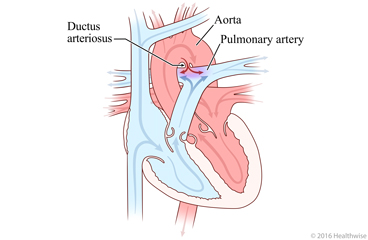
Patent ductus arteriosus (PDA) is a type of congenital heart disease. Congenital heart disease refers to
heart problems a baby is born with.
In PDA, an opening near the heart called the ductus arteriosus fails to close after birth. ("Patent" means
open.)
The heart has two major blood vessels attached to it: the aorta and the pulmonary artery.
Before birth, your baby (fetus) lives in amniotic fluid. So your baby doesn't breathe through the lungs.
Instead, the ductus arteriosus helps the baby's body get red blood from the mother. Normally this opening
closes shortly after birth because the baby doesn't need it anymore.
If the opening stays open, some of the red blood in the aorta flows back into the pulmonary artery and to the
lungs instead of to the rest of the body. Because some of the red blood that was supposed to go to the body is
going to the lungs, the heart may have to pump harder to get red blood to the body.
But sometimes a PDA is so small that the heart doesn't have to work harder and there are no symptoms.
It can be scary to learn that there is something wrong with your baby's heart. The hospital staff understands
this. They will explain what happens and will answer your questions.
How is PDA diagnosed?
Your doctor may hear abnormal heart sounds, such as a heart murmur, when examining your newborn.
Your doctor will order tests to find the cause of abnormal sounds or of symptoms. The most common test used
to identify this problem is called an echocardiogram, or "echo" for short. It uses sound waves to make an
image of your baby's heart.
Your baby may have other tests, such as an EKG (electrocardiogram), chest X-ray, and checking the amount of
oxygen in the blood.
What are the symptoms?
Symptoms depend on how big the opening is. Babies with a mild PDA have smaller openings. These babies may not
have symptoms.
But if the opening is larger, symptoms may include:
How is it treated?
In mild cases, the opening may close on its own. It may take from a few days to several months. No treatment
is needed.
And treatment is usually not needed if your baby has no symptoms.
What can you expect?
Your doctor will explain what symptoms to watch for at home. Regular checkups will help your doctor watch
your baby for symptoms over time.
Follow-up care is a key part of your child's treatment and safety. Be sure to make and go to all
appointments, and call your doctor if your child is having problems. It's also a good idea to know your
child's test results and keep a list of the medicines your child takes.
Current as of: June 24, 2023
Content Version: 14.0
Care instructions adapted under license by your
healthcare professional. If you have questions about a medical condition or this instruction, always ask
your healthcare professional. Healthwise, Incorporated disclaims any warranty or liability for your use of
this information.