Learning About Appendectomy
What is an appendectomy?
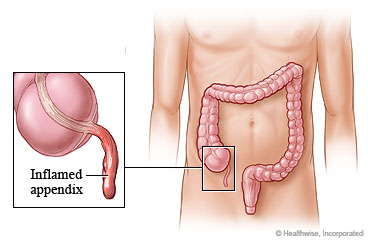
An appendectomy is surgery to take out the appendix. This organ is a small sac that is shaped like a finger.
It's attached to your large intestine.
Appendicitis happens when the appendix becomes infected and inflamed. An appendectomy is the main treatment
for it. If surgery is delayed, the inflamed appendix may burst. A burst appendix can cause serious health
problems.
If your appendix has burst, you may need an emergency surgery to remove the burst appendix.
How is this surgery done?
Before surgery, you will get medicine to make you sleep.
Appendectomy is usually done as a laparoscopic surgery. That means it is done with only small cuts. These
cuts are called incisions. The doctor puts a lighted tube, or scope, and other surgical tools through the cuts
in your belly. The doctor is able to see your organs with the scope. The doctor removes the appendix. The cuts
heal quickly, and the scars usually fade over time.
In some cases, the surgery is done through a single larger cut in the belly. This is called open surgery.
What can you expect after surgery?
Most people leave the hospital 1 or 2 days after surgery. Some even go home the same day.
After you go home, it is normal to feel weak and tired for several days. Your belly may be swollen and may be
painful. If you had laparoscopic surgery, you may have shoulder pain. This is caused by the air the doctor put
in your belly to help see the organs better. The pain may last for a day or two.
You may also have nausea or vomiting and have diarrhea, constipation, gas, or a headache. These problems
usually go away in a few days.
Your recovery time depends on the type of surgery you had. If you had laparoscopic surgery, you will probably
be able to go back to work or your normal routine in a couple of weeks after surgery. If you had an open
surgery, it may take longer. If your appendix burst, you may have a drain in your incision.
Your body will work fine without an appendix. You won't have to make any changes in your diet or daily life.
After surgery, be sure to follow your doctor's advice about problems to watch for. These may include fever,
worse belly pain, or problems with your incision.
Follow-up care is a key part of your treatment and safety. Be sure to make and go to all
appointments, and call your doctor if you are having problems. It's also a good idea to know your test results
and keep a list of the medicines you take.
Current as of: July 26, 2023
Content Version: 14.0
Care instructions adapted under license by your
healthcare professional. If you have questions about a medical condition or this instruction, always ask
your healthcare professional. Healthwise, Incorporated disclaims any warranty or liability for your use of
this information.