Learning How to Use an External (Male) Condom
What is an external (male) condom?
An external (male) condom is a tube made of latex (rubber), soft
plastic, or natural membrane (lambskin) with a closed end. It fits
over the penis.
Condoms can be used to prevent pregnancy. They can also help protect
against sexually transmitted infections (STIs). You must use a new
condom every time you have sex.
Condoms prevent pregnancy by keeping sperm and eggs apart. The
condom holds the sperm so the sperm can't get into the vagina.
There are many kinds of external condoms. Some condoms are
lubricated. Some are ribbed. Most have a "reservoir tip" for holding
the semen. You can also buy condoms of different sizes.
How well does it work?
When external condoms are used exactly as directed, they are
about 98% effective for preventing pregnancy. This means that 2 out
of 100 people who use them will have an unplanned pregnancy. When
they are not used exactly as directed, they are about 87%
effective for preventing pregnancy. This means that 13 out of 100
people who use them will have an unplanned pregnancy.
A common reason for failure is not using a condom every time you
have sex. Another common reason for failure is that the condom may
break or partially or completely slip off the penis. Condoms slip
more often than they break. If you use a lubricant, don't use an
oil-based lubricant. Oil can weaken the condom so that it breaks.
Use a water-based lubricant.
How do you use a condom?
Condoms work best if you follow these steps.
-
Use a new condom each time you have sex.
-
Check the condom's expiration date. Do not use it past that date.
-
When opening the condom wrapper, be sure not to poke a hole in the
condom with your fingernails, teeth, or other sharp objects.
-
Put the condom on as soon as the penis is hard (erect) and before
any sexual contact with your partner.
-
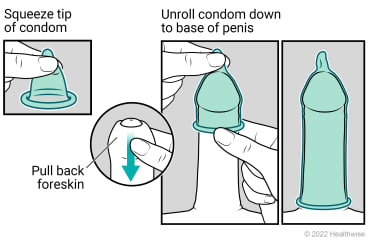
First, hold the tip of the condom and squeeze out the air.
This leaves room for the semen after you ejaculate.
-
If you are not circumcised, pull down the loose skin from the
head of the penis (foreskin) before you put on the condom.
-
Hold on to the tip of the condom as you unroll the condom.
Unroll it all the way down to the base of the penis.
-
After you ejaculate, hold on to the condom at the base of the
penis, and withdraw from your partner while your penis is still
erect. This will keep semen from spilling out of the condom.
-
Wash your hands after you handle a used condom.
How do you buy and store condoms?
-
External condoms may be available for free at family planning
clinics. You can buy them without a prescription at drugstores,
online, and in some grocery stores.
-
Keep condoms wrapped in their original packages until you are
ready to use them. Store them in a cool, dry place out of direct
sunlight.
-
Don't keep rubber (latex) condoms in a glove compartment or other
hot places for a long time. Heat weakens latex and increases the
chance that the condom will break.
-
Don't use condoms in damaged packages. And don't use condoms that
are brittle, sticky, or discolored, even if they are not past
their expiration date.
What else do you need to know?
-
To protect yourself and your partner from sexually transmitted
infections (STIs), use a condom during vaginal, oral, or anal sex.
You can use an external condom at the same time as you are using
another form of birth control.
-
You can use a condom with hormonal contraception, an
intrauterine device (IUD), a diaphragm, a sponge, a shield, or
a cervical cap.
-
Don't use an external condom with an internal (female) condom.
-
If you use spermicide with a condom, don't put spermicide
inside the condom.
-
If the condom breaks or you think sperm may have leaked out into
the vagina, you can use emergency contraception to help prevent
pregnancy. The most effective emergency contraception is an IUD
(inserted by a doctor). You can also get emergency contraceptive
pills. You can get them with a prescription from your doctor or
without a prescription at most drugstores.
-
If you or your partner gets a rash or feels itchy after using a
latex condom, talk to your doctor. You may have a latex allergy.
Current as of: May 5, 2025
Content Version: 14.6
Care instructions adapted under license by your healthcare
professional. If you have questions about a medical condition or
this instruction, always ask your healthcare professional. Ignite
Healthwise, LLC, disclaims any warranty or liability for your use
of this information.